Dishwasher Pods vs. Powder vs. Gel: Which Detergent Should You Use?
Each detergent form has trade-offs in convenience, dosing and price. Here's how to choose, plus how to store pods safely around children.
All three forms of automatic dishwasher detergent can clean well; the best choice depends on your water and habits. Pods and tablets are the most convenient and often include extras like rinse aid and enzymes; powder lets you adjust the dose for hard or soft water and is often cheaper per load; gel is easy to pour but tends to have fewer enzymes and is less common. Whatever you use, store it out of children’s sight and reach: concentrated detergent can cause serious injury if swallowed or splashed in the eyes.
How dishwasher detergent works
Dishwasher detergents are different from hand dish soap. They’re designed to produce very little foam, and they typically combine several ingredients:
- Alkaline builders (such as carbonates and silicates) that loosen grease and soften water
- Enzymes that break down proteins (egg, meat) and starches (rice, pasta, potatoes)
- Bleaching agents (often oxygen-based) for tea, coffee and tomato stains
- Surfactants in small amounts to help water wet the dishes
- Sometimes rinse aid or anti-filming agents
Since 2010, most US dishwasher detergents have been made with little or no phosphate, after a number of states limited phosphorus content. Phosphates had helped soften water, so some people with hard water noticed more spots and film after the change. Today’s formulas use other water softeners, but very hard water can still leave residue.
Pods vs. powder vs. gel compared
| Pods / tablets | Powder | Gel / liquid | |
|---|---|---|---|
| Convenience | Easiest, no measuring | Measure each load | Pour each load |
| Dose control | Fixed | Fully adjustable | Adjustable |
| Extras | Often multi-chamber with enzymes, rinse aid | Varies by product | Usually fewer enzymes |
| Hard water | May need rinse aid and a booster | Can add more for hard water | Can struggle in very hard water |
| Cost per load | Usually highest | Usually lowest | Usually in between |
| Storage | Keep dry and sealed, out of children’s reach | Keep dry; clumps in humidity | Keep cap closed |
Prices change and vary by brand and pack size, so compare the price per load on the shelf tag or listing rather than the package price.
Which to pick for your situation
Hard water
Powder lets you increase the dose. A detergent labeled for hard water, plus rinse aid in the dispenser, often helps. If your dishwasher has a built-in water softener (common on European-made models), set its hardness level according to the manual. See how to remove hard water stains in a dishwasher.
Soft water
Too much detergent in soft water can etch glassware over time. Powder or a smaller dose helps; follow the package directions for soft water.
Quick cycles
Some pod films and compressed tablets may not dissolve fully on very short cycles. Check the package for cycle guidance.
How to use pods correctly
- Handle pods with dry hands; the film dissolves on contact with water.
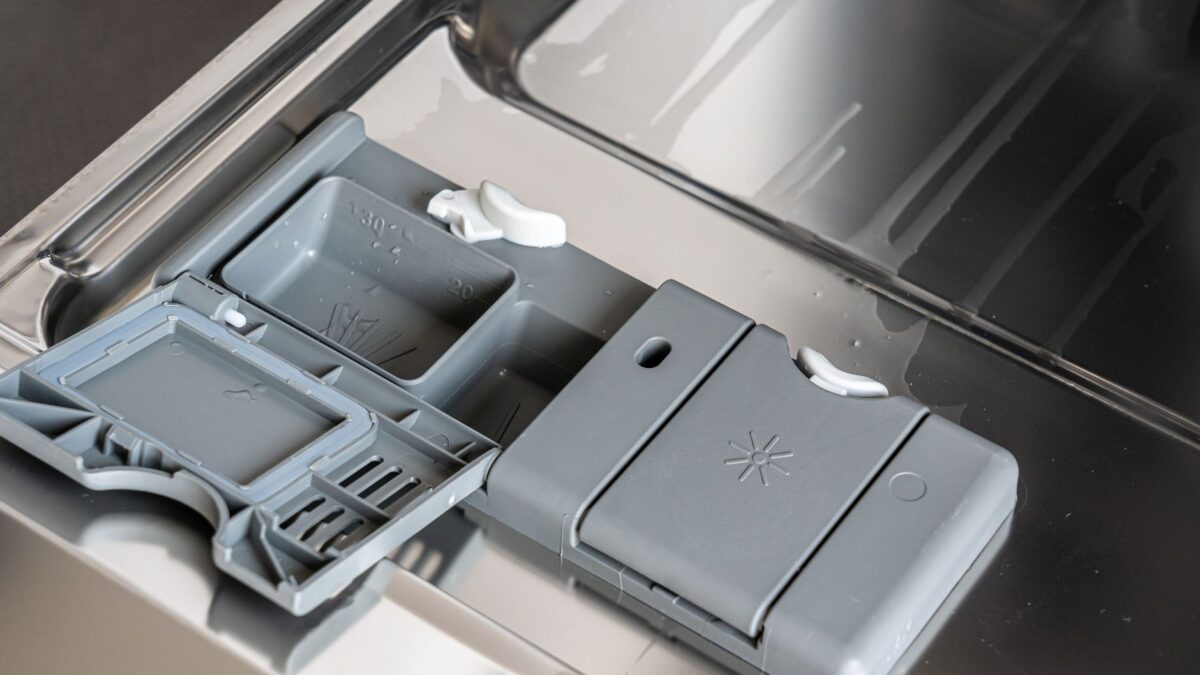
- Place the pod in the detergent dispenser and close the lid, unless the manufacturer of your detergent or dishwasher says otherwise.
- Don’t block the dispenser door with tall items on the bottom rack.
- Close the pod container immediately after taking one out.
If you find a sticky, half-dissolved pod in the dispenser after a cycle, the dispenser door may be blocked, the water may not be hot enough, or the detergent may be old. Our guide to a dishwasher not cleaning dishes goes through more checks.
Child safety
Children’s hospitals and poison centers advise storing all detergents, especially pods, up high, out of sight and out of reach of young children, ideally in a locked cabinet, in their original containers. Child-resistant packaging helps but isn’t foolproof. Load the detergent just before you run the machine, and check the dispenser after each cycle for leftover detergent.
If a child swallows detergent or gets it in their eyes, call Poison Control right away at 1-800-222-1222 (US). Call 911 if they have trouble breathing or are unresponsive. Don’t make the child vomit unless told to by Poison Control.
Things not to use
- Hand dish soap: it creates suds that can overflow the machine and leak from the door.
- Laundry detergent: not formulated for dishwashers.
- Homemade mixes with bleach and vinegar together, or other combinations of acids and chlorine: they can release toxic gas.
Storage and shelf life
Moisture is the enemy of all three types. Powder clumps, pods stick together and tablets crumble or swell when they absorb humidity. Store detergent in its closed original container, in a cool, dry place away from the sink and dishwasher vent, and buy pack sizes you’ll use within a few months. If powder has formed hard lumps, it may not dissolve well; small soft clumps can usually be broken up.
Using a detergent booster
In very hard water, some people add a citric acid-based booster or rinse agent alongside their regular detergent. Follow both product labels, and never combine products containing chlorine bleach with acids. If you use a booster, a monthly empty cleaning cycle may still help with scale in the tub.
Bottom line
Choose pods for convenience, powder for flexible dosing and lower cost per load, and gel only if it works well with your water. Use rinse aid if your water is hard, keep the filter clean, and keep every type of detergent locked away from children.
FAQ
Are expensive pods worth it?
They may include more enzymes and extras, which some households notice on tough loads. Try a few loads with a cheaper option first, since water hardness and your dishwasher matter as much as the detergent.
Can I cut a pod in half?
No. The film is designed to dissolve whole, and cutting it exposes concentrated detergent.
Do I still need rinse aid with all-in-one pods?
Many dishwasher makers still recommend filling the rinse aid dispenser for better drying and fewer spots, especially in hard water.