Oven Temperature Not Accurate? How to Check, Adjust and Test the Sensor
Most ovens cycle above and below the set point, so a single reading means little. A proper check takes about 30 minutes and an inexpensive thermometer.
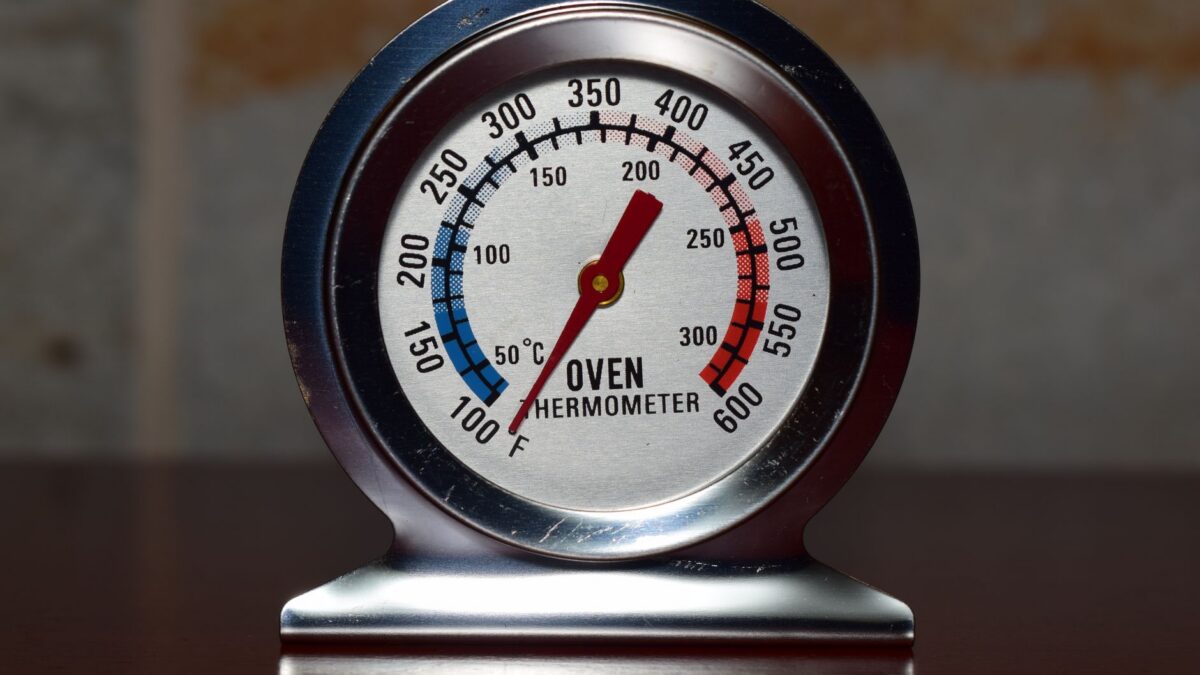
To find out whether your oven is really off, place an oven thermometer in the center, set it to 350°F, and take several readings over 20–30 minutes after preheating; the average is what counts, because ovens normally cycle above and below the set point. If it’s consistently off, most modern ovens let you enter a temperature offset through the controls (the allowed range varies by model). If it’s off by a lot, swings wildly or won’t reach temperature, the temperature sensor, door seal or heating element may be at fault. Turn off power before inspecting any part.
Why ovens drift
An oven thermostat or electronic control switches the heat on and off to hold an average temperature. Swings of a couple of dozen degrees around the set point are normal for many ovens. Real problems come from:
- A worn or damaged door gasket letting heat escape
- A failing temperature sensor (a thin metal probe at the back of the cavity on electronic models)
- A weak bake or broil element (electric) or a weak igniter (gas)
- A control board or thermostat fault
- Simple causes: opening the door often, covering vents or the oven floor with foil, or a thermometer placed too close to a heating element
What you need
- An oven thermometer (dial or digital with a probe)
- Oven mitts and a notepad
- Your manual (model number on a label around the oven frame, drawer or door edge)
- For a sensor check only: a multimeter
Step-by-step: check the real temperature
- Position the thermometer on the center rack, middle of the oven, away from walls and elements.
- Preheat to 350°F and wait until the oven signals it’s ready, then another 10 minutes.
- Read through the window every 5–10 minutes for 20–30 minutes, opening the door as little as possible. Write down each reading.
- Average the readings. A few degrees off is fine for most cooking; a consistent difference of about 15–25°F or more is worth correcting.
- Optional: repeat at a higher setting such as 425°F to see whether the error is constant or grows with temperature.
Don’t rely on a single reading taken right after the preheat beep; many ovens signal “ready” before the cavity and walls are fully settled.
How to adjust (calibrate) the temperature
Electronic controls
Most digital ovens have a hidden temperature offset setting. It’s typically reached by holding a key or a combination (often Bake, or Bake plus another key) for a few seconds, then entering a number of degrees up or down. The exact steps and maximum adjustment vary by model, so follow your manual or the manufacturer’s online support. This shifts the oven’s target; it doesn’t fix a failing part.
Dial thermostats
Some older ovens have an adjustment screw behind the temperature knob or in the thermostat itself. Pull the knob straight off and look for a screw or a movable plate. Instructions differ by model; if your manual doesn’t describe it, a technician can adjust or replace the thermostat.
The simplest workaround
If your oven consistently runs about 20°F cool, you can set it 20°F higher. Keep the thermometer in the oven to confirm.
Symptom guide
| Symptom | Likely cause | Next step |
|---|---|---|
| Consistently off by the same amount | Calibration drift | Use the offset setting |
| Wild swings, burnt and raw spots | Sensor, thermostat or control | Check sensor; call a technician |
| Slow to heat or never reaches temperature (electric) | Weak bake element | Inspect element for breaks or blisters; call a pro |
| Slow to heat or never reaches temperature (gas) | Weak igniter | Call a technician |
| Heat escaping around door, browning on one side | Worn gasket or door not closing | Inspect seal; replace per manual |
| Error code about temperature or sensor | Sensor or wiring fault | Check manual for the code; call a technician |
Ovens sometimes develop heating problems right after a high-heat clean cycle. See how self-cleaning ovens work for precautions.
Testing the temperature sensor
This is for confident DIYers on electric or electronically controlled ovens. Unplug the range or switch off its breaker first. For gas ranges, leave everything on the gas side alone.
- Locate the sensor: a thin probe on the back wall of the oven, usually near the top.
- Check visually that it isn’t touching the oven wall or bent.
- On many models, removing two screws lets you pull the sensor forward slightly to reach its connector. Don’t pull hard on wires.
- Disconnect the connector and measure resistance across the sensor terminals with a multimeter.
- Compare with the manufacturer’s specification, usually in the service sheet or on the part listing. Many common sensors read roughly 1,100 ohms at room temperature, but values vary by brand.
A reading far outside the spec suggests a bad sensor. A normal reading but continued problems points to wiring, the control board or another part.
When to call a pro
- The oven won’t reach temperature, or the offset doesn’t correct the problem.
- Any gas oven heating issue, including a weak igniter; if you smell gas, leave the home and call your gas utility or 911 from outside.
- Control board or thermostat faults, or wiring problems.
- You’re not comfortable working with the range disconnected and pulled out.
Use a qualified appliance technician, and check your warranty first, since DIY repairs may void it. Burners on the cooktop behaving oddly too? See electric stove burner not working.
Bottom line
Check with a thermometer over 20–30 minutes and average the readings. If the oven is steadily off, use the built-in offset. Large swings, failure to reach temperature or error codes point to a part such as the sensor, element, igniter or control. Test the sensor only with power off, and leave gas-side work to a pro.
FAQ
How far off is normal for an oven?
Short swings above and below the set point are normal. What matters is the average over time. A steady error of 15–25°F or more is worth correcting.
Where should I put an oven thermometer?
Center rack, middle of the oven, away from walls and heating elements.
Does calibrating fix a bad sensor?
No. An offset only shifts the target temperature. A sensor that reads erratically needs replacing.
Why are my cakes burning on the bottom?
Possible causes include the oven running hot, a dark pan, the rack too low, or foil on the oven floor. Check temperature first.