How Does an Air Fryer Work? Convection, Explained Simply
What actually happens inside an air fryer, why it browns food quickly, and how basket, dual-basket and oven-style models differ.
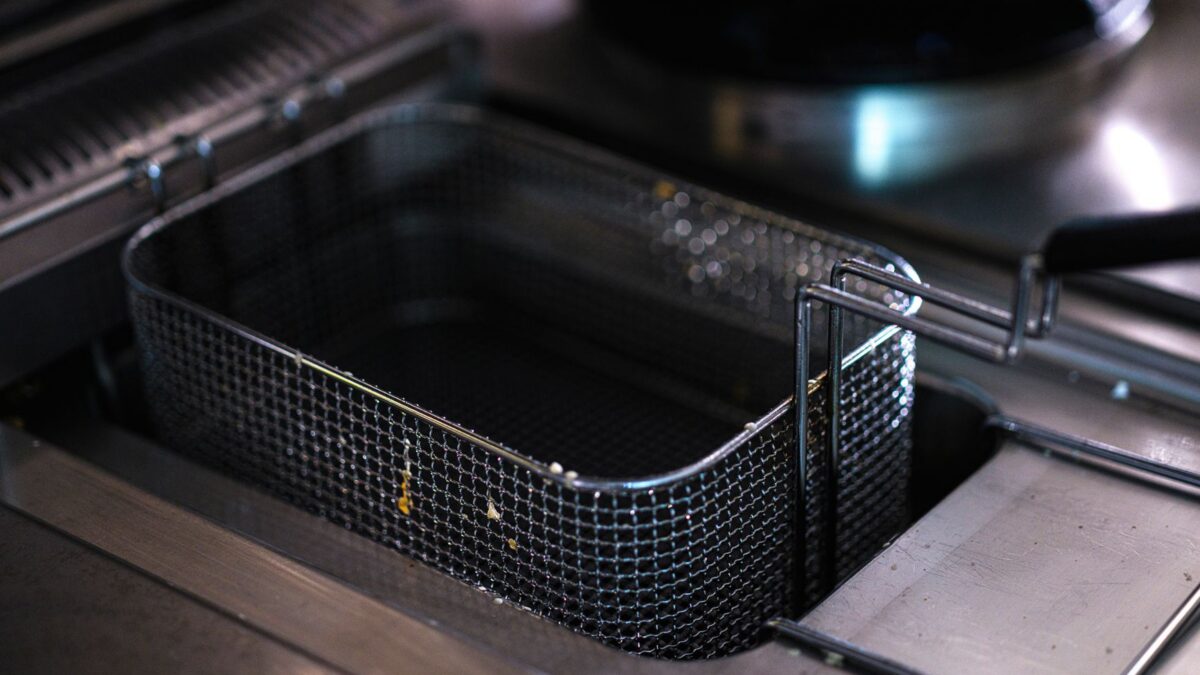
An air fryer does not fry. It is a compact countertop convection oven: an electric heating element sits above the food, and a fan blows the heated air down and around it at high speed. Because the cooking chamber is small and the air moves fast, the surface of the food dries and browns quickly, giving a crisp result with far less oil than deep frying. The trade-off is limited space and the need to cook in a single layer.
The parts inside
- Heating element. Usually a coiled metal element at the top of the cooking chamber, behind a protective screen. It heats the air and also radiates heat directly onto the top of the food.
- Fan. Mounted above or behind the element, it pushes hot air through the chamber. This is what separates an air fryer from a simple toaster.
- Basket or trays. Perforated or mesh surfaces let air reach the underside of the food. Many baskets have a nonstick coating; some are stainless steel or ceramic-coated.
- Drawer or drip tray. Collects fat and crumbs that fall through.
- Thermostat and controls. A temperature sensor cycles the element on and off to hold the set temperature, often adjustable up to around 400–450°F depending on the model. A timer shuts the heat off at the end.
- Safety cutoffs. Most basket models stop heating when the drawer is pulled out, and units typically include a thermal fuse or cutoff to stop overheating.
Why food browns so fast
Browning depends mostly on two things: a dry surface and a high surface temperature. The fast-moving air in an air fryer strips away the thin layer of moist, cooler air that normally clings to food. That speeds up heat transfer and evaporation, so the surface dries and reaches browning temperatures sooner than it would in still air at the same setting.
Once the surface is dry and hot, the Maillard reaction (browning of proteins and sugars) and caramelization take over. That is where the golden color and roasted flavor come from. A thin coat of oil helps by conducting heat evenly across the surface, which is why lightly oiled potatoes crisp better than dry ones.
The same physics explains the main rule of air frying: do not crowd the basket. Food piled up blocks the airflow and traps steam, so the pieces in the middle steam instead of browning. USDA guidance on air fryers makes the same point, noting that overcrowding can keep food from cooking properly. See USDA FSIS: Air Fryers and Food Safety.
Air frying vs deep frying
| Air fryer | Deep fryer | |
|---|---|---|
| Heat transfer | Hot moving air (convection) plus radiant heat from the element | Hot oil surrounding the food |
| Oil used | None to a tablespoon or so | Enough to submerge the food |
| Texture | Crisp, drier, more like roasting | Uniformly crisp, richer |
| Wet batters | Do not work well; batter drips through | Work well |
| Cleanup | Basket and drawer | Oil to filter, store or dispose of |
Because the heat comes through air rather than oil, an air fryer cannot set a runny batter. Breaded foods, frozen snacks, vegetables and naturally fatty foods such as wings and sausages work best.
Basket vs oven-style vs dual basket
Single-basket models
The most common design. A pull-out drawer holds a basket, usually somewhere between about 2 and 7 quarts. The chamber is compact and tall, so air moves quickly and preheating takes little time. You shake the basket to turn food. Capacity is limited by the floor area, not the quart number, since food works best in one layer.
Dual-basket models
Two separate drawers, each with its own element and fan, so you can cook two foods at different temperatures. Many have a feature that adjusts start times so both finish together. Each basket is smaller than a single large basket of the same total capacity, which matters for big items such as a whole chicken.
Oven-style models
Look like a toaster oven with a front door, often with a window, several racks and sometimes a rotisserie. They offer more flat cooking area and let you see the food, but airflow is usually less concentrated than in a tall basket, so food may need to be rotated between racks. Many double as toaster ovens. For more on that overlap, see our comparison of an air fryer vs a convection oven.
Power and electricity
Most countertop air fryers are rated somewhere around 1,200–1,800 watts; the exact figure is on the label and in the manual. On a standard US 120-volt, 15-amp kitchen circuit, an 1,800-watt appliance draws close to the circuit’s full capacity, so running it at the same time as a kettle or toaster on the same circuit can trip the breaker. Plug it directly into a wall outlet, not an extension cord or power strip. Our air fryer safety tips cover placement and cords in more detail.
Because the chamber is small, an air fryer usually heats up faster than a full-size oven, which can make it cheaper to run for small portions. For large batches that need several rounds, a full oven may make more sense.
What an air fryer does not do well
- Wet batters, as above.
- Large quantities at once; you will often cook in batches.
- Light, loose foods such as leafy greens or loose seasonings can be blown around and land near the element.
- Some raw stuffed breaded chicken products: USDA advises not cooking raw, stuffed, breaded chicken breast products in an air fryer, because they may not cook evenly to a safe temperature.
Bottom line
An air fryer is a small, high-powered convection oven. Fast-moving hot air dries and browns food quickly, so it crisps with little oil, but only when the pieces have room. Choose a basket model for speed and simplicity, a dual basket for two dishes at once, or an oven style for more flat space and visibility. If you are choosing one, start with what size air fryer you need.
FAQ
Is an air fryer just a convection oven?
Essentially yes. It uses the same principle, but in a smaller chamber with a fan that moves air faster and closer to the food.
Do air fryers need oil?
Not always. Fatty foods and most frozen snacks need none. A teaspoon or two of oil helps fresh vegetables and potatoes brown evenly.
Why does an air fryer need space around it?
It pulls in air and exhausts hot air, usually from the back. Blocking the vents can cause overheating; follow the clearance in your manual.
Do air fryers make food healthier?
They use much less oil than deep frying, which reduces the fat absorbed from frying oil. What you cook still matters more than the appliance.