Microwave Not Heating? Safe Checks and When to Call a Technician
When the light and turntable work but food stays cold, the fault is almost always inside the high-voltage circuit. Here's what you can safely rule out first.
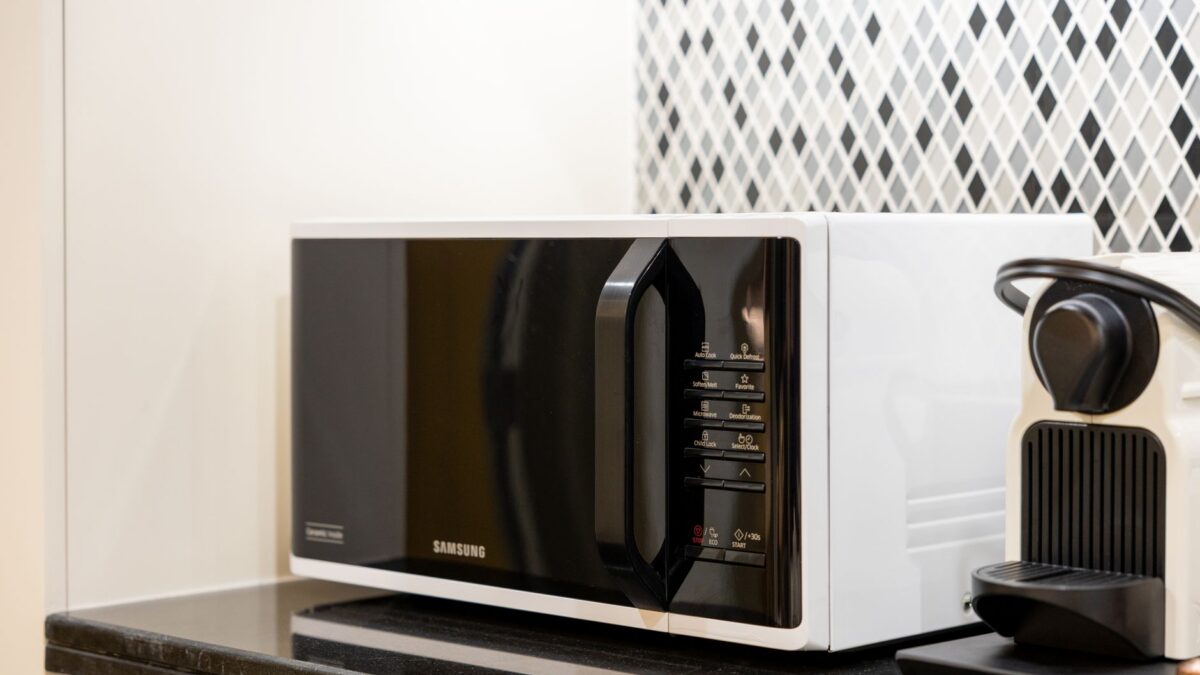
When a microwave runs, lights up and spins but food stays cold, the fault is usually in the high-voltage heating circuit: a failed door switch, high-voltage diode, capacitor or the magnetron that makes the microwaves. You can safely rule out settings, power and the door in about 10 minutes. Do not open the cabinet: the high-voltage capacitor can hold a lethal charge even when the microwave is unplugged, so internal testing and repairs are for qualified technicians only.
First, rule out the simple things
These checks need no tools and involve nothing inside the case.
- Test with water. Put 1 cup of water in a microwave-safe mug and heat on high for 1 minute. In a working oven it should be noticeably hot. This tells you whether the oven heats at all or just heats weakly.
- Check the power level. It’s easy to leave an oven on a low power setting or in a defrost mode. Reset to full power.
- Look for a demo mode. Many microwaves have a showroom or demo mode where the display, light and turntable work but the magnetron does not. The manual explains how to switch it off; it’s often a long press of a specific key.
- Check the outlet and circuit. Microwaves draw a lot of current. If the oven shares a circuit with a kettle or toaster, voltage can sag. Try it alone on the circuit. If the breaker trips, see our guide to resetting a tripped breaker.
- Close the door firmly. Open and shut it a few times. If it doesn’t latch cleanly, the door switches may not engage. A door that is bent, warped or won’t close properly is a reason to stop using the oven and contact the manufacturer, as the FDA advises.
- Power-cycle it. Unplug for a few minutes, then plug back in. Electronic controls sometimes recover from a glitch.
What usually fails (and why it’s not DIY)
Inside a typical microwave, a high-voltage transformer, capacitor and diode supply several thousand volts to the magnetron. Several parts commonly fail:
| Part | Typical symptom | DIY? |
|---|---|---|
| Door switches (interlocks) | No heat, oven stops or blows a fuse when door closes | No: technician; switches sit inside the case |
| High-voltage diode | Runs normally, no heat; sometimes loud hum | No: high-voltage circuit |
| High-voltage capacitor | No heat, buzzing | Never: stores a lethal charge |
| Magnetron | No heat or weak heat, buzzing, burning smell | No: technician |
| Thermal fuse or thermostat (thermoprotector) | Oven dead or no heat after overheating | No: located inside case |
| Control board | Erratic display, no heat, keys don’t respond | No: technician |
You’ll find online videos showing people testing these parts with a multimeter. The risk isn’t worth it. Discharging the capacitor safely requires training and the right tools, and the voltages involved can kill. Opening the case may also void the warranty.
Symptoms that help a technician
You can save a technician time by noting exactly what happens:
- Does the display, light and turntable work?
- Is there a loud hum or buzz that’s louder than usual?
- Does it heat a little (weak) or not at all?
- Did it stop suddenly after sparking, a burning smell or a popping sound? (See microwave sparking inside.)
- Did a fuse blow or a breaker trip?
- The model and serial number, usually on a label inside the door frame, on the side or on the back.
Repair or replace?
As of 2026, rough figures from cost guides and repair services put a typical microwave repair at somewhere around $100–$200, with magnetron jobs often more, and many shops charge a separate service-call fee. Prices vary widely by region and by type of microwave. Treat these as ballpark ranges and get a written quote.
| Situation | Usually makes sense to |
|---|---|
| Inexpensive countertop model, out of warranty | Replace; repair can approach the price of a new unit |
| Countertop model still under warranty | Contact the manufacturer; don’t open it |
| Over-the-range or built-in model | Get a repair quote; replacement means installation cost too |
| Older oven with rust inside, damaged door or repeated failures | Replace |
If you’re replacing, our comparison of over-the-range vs countertop microwaves covers venting, sizing and installation.
Check for a recall
Before paying for repair, search your brand and model at CPSC.gov recalls. If a recall applies, follow the remedy stated in the notice (repair, refund or replacement).
Disposing of an old microwave
Don’t take it apart for parts. Many cities and retailers accept small appliances for electronics recycling; check your local waste program.
When to call a pro
Call a qualified appliance technician or the manufacturer’s service line whenever the simple checks above don’t restore heating. That covers any suspected door switch, diode, capacitor, magnetron, fuse or control board problem. Stop using the microwave immediately if it runs with the door open, sparks with no metal inside, smokes or smells like hot wiring.
Bottom line
Do the free checks first: a water test, the power level, demo mode, the outlet, the door latch and a power cycle. If it still won’t heat, the problem is inside the high-voltage circuit. That’s technician territory because of the capacitor’s stored charge. For a cheap countertop model, replacing it is often the most economical option.
FAQ
Why does my microwave run but not heat?
Most often a failed high-voltage diode, door switch, capacitor or magnetron. All of them sit inside the case and should be diagnosed by a technician.
Is it safe to keep using a microwave that heats weakly?
If it heats evenly and the door closes properly, it’s usually just slow. If you also hear loud buzzing, smell burning or see sparks, stop using it.
Can I discharge the capacitor myself?
No. It can hold a dangerous charge even after unplugging, and doing it wrong can be fatal. Leave it to a trained technician.
How long do microwaves typically last?
It varies with use and model; many people replace countertop units after several years. Repeated failures or a damaged door are good signs it’s time.