Convection vs Conventional Oven: Settings and Conversions
Use convection for roasting and sheet-pan baking, and conventional bake for cakes and custards. Lower the temperature 25°F (15°C) and check early.
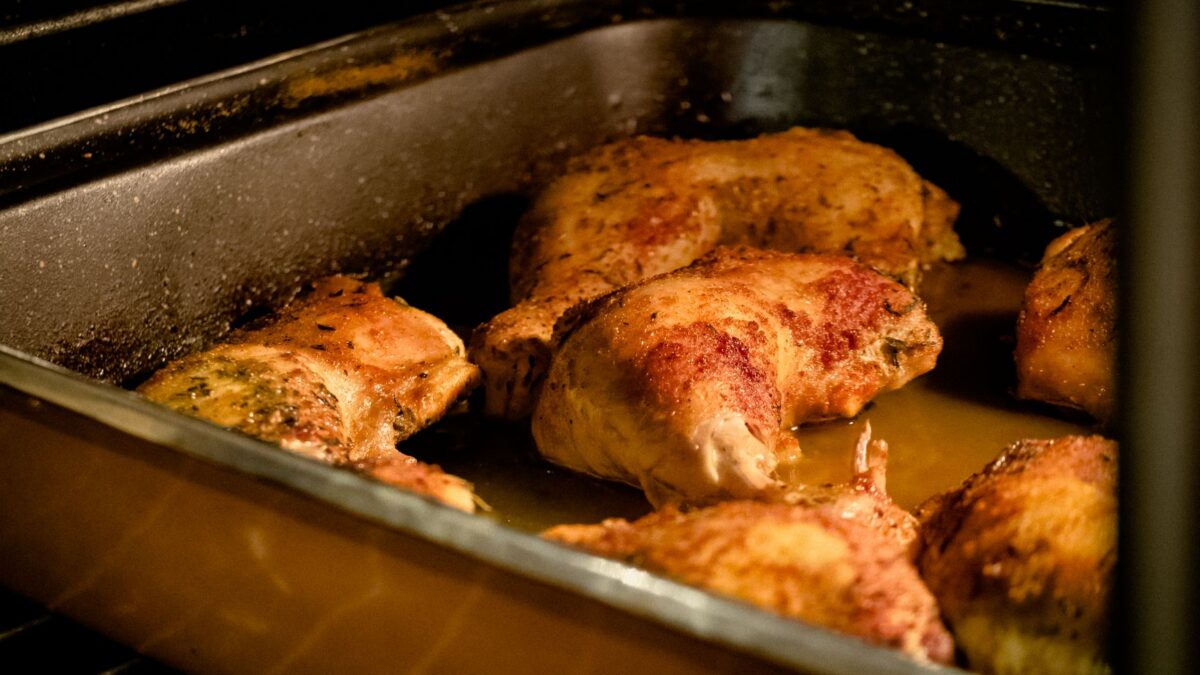
A convection oven setting runs a fan that moves hot air around the food, so it cooks faster and browns more evenly than a conventional (standard bake) setting. The usual conversion is to lower the recipe temperature by 25°F (about 15°C), for example 350°F (175°C) becomes 325°F (165°C), and to start checking the food at roughly 75 to 90 percent of the listed time.
Convection suits roasts, vegetables, sheet-pan cookies and pastry. Conventional bake suits cakes, custards and other delicate batters that need gentle, still air.
What does the convection setting actually do?
The fan, usually at the back of the oven, pushes air past the food and keeps the temperature the same in every corner of the cavity. Moving air also strips away the thin layer of cooler, moist air that sits around the food, which speeds up browning and crisping. Some ovens add a third heating element around the fan; these are often called true or European convection.
A conventional setting relies on heating elements at the top and bottom, with air that stays mostly still. Hot and cool spots are more common, and the top rack usually browns fastest.
When should you use convection?
Use convection for foods that benefit from dry, circulating heat:
- Roasted chicken, turkey pieces, pork and other meats, where crisp skin and browning matter.
- Roasted vegetables and potatoes, which brown instead of steaming.
- Cookies on one or two sheet pans, so every tray bakes evenly.
- Puff pastry, pie crusts, turnovers and croissants, which rise and crisp well in moving air.
- Toasted nuts, granola and frozen snacks that should come out crisp.
- Cooking on several racks at once, since the fan reduces differences between racks.
When should you use the conventional setting?
Choose conventional bake when moving air could dry out or disturb the food. Cakes, cupcakes and quick breads can set unevenly or form a dry crust. Custards, cheesecakes, flan and souffles are delicate, and moving air can ripple the surface or cause cracks. Foods covered tightly with foil or a lid, such as casseroles and braises, gain little from a fan because the cover blocks the airflow.
Batters that rely on slow, steady rise are the main reason bakers keep the standard setting on hand. If your recipe does not say which setting to use, bake is the safe default for these foods.
How do you convert time and temperature for convection?
Take the recipe temperature and lower it by 25°F (about 15°C). If the recipe was written for convection and you are using a conventional oven, raise it by 25°F instead. Keep the preheating step the same: preheat the oven to the adjusted temperature before the food goes in.
For time, begin checking at about three-quarters to nine-tenths of the listed time. Many roasts finish 10 to 25 percent sooner on convection, while baked goods vary more, so go by color and doneness rather than the clock alone.
- Recipe says 400°F (200°C) conventional: set convection to 375°F (190°C).
- Recipe says 350°F (175°C) conventional: set convection to 325°F (165°C).
- Recipe says 60 minutes: check around 45 to 55 minutes.
Some ovens have a convection conversion feature that lowers the temperature automatically when you choose convection. Check the manual first, since applying the 25°F reduction on top of an automatic one can leave food undercooked.
Does convection roast differ from convection bake?
On many ovens the two modes differ. Convection bake normally uses the lower element plus the fan at a gentle level, which suits baked goods. Convection roast typically adds the upper element for stronger browning and is meant for meat and vegetables. Naming and behavior differ by manufacturer, so the owner’s manual or the manufacturer’s support site is the reliable guide.
What mistakes spoil convection results?
- Using deep or covered pans. Low-sided pans and sheet pans let air reach the food. Tall sides block the airflow.
- Crowding the oven. Leave space around pans so the air can move. Two racks work well when the pans do not touch the walls.
- Skipping the rotation. Even with a fan, rotate pans between racks halfway through when the food is browning unevenly.
- Trusting the dial. If food keeps finishing early or late, the oven itself may be off. See how to check and adjust oven temperature accuracy.
- Relying on color alone for meat. Brown skin does not prove the inside is safe.
Use a food thermometer. The USDA Food Safety and Inspection Service gives 165°F (74°C) as the safe minimum internal temperature for poultry, and the same thermometer check applies whichever oven setting you use.
How does this help with a crowded holiday oven?
When several dishes share one oven, convection helps because the fan evens out heat between racks. Planning rack positions and staggering start times still matters; this guide to cooking holiday dishes in one oven covers it. If you also own an air fryer, the comparison of air fryers and convection ovens explains how the same idea works at a smaller scale.
Quick answers
Can I use convection for everything?
No. It works for most roasting and for sheet-pan baking, but cakes, custards and covered dishes usually come out better on the conventional setting.
Do I still preheat on convection?
Yes. Preheat to the adjusted temperature, and wait for the oven to signal it is ready. Food placed in a cold oven cooks unevenly.
Is the fan noise normal?
A steady hum or whoosh is normal while the fan runs. Grinding, rattling or a fan that does not start is a reason to contact the manufacturer or a qualified repair technician, and to unplug the oven before any inspection.
What if the recipe was written for convection?
On a conventional setting, raise the temperature by 25°F (about 15°C) and allow a little more time, then check for doneness.